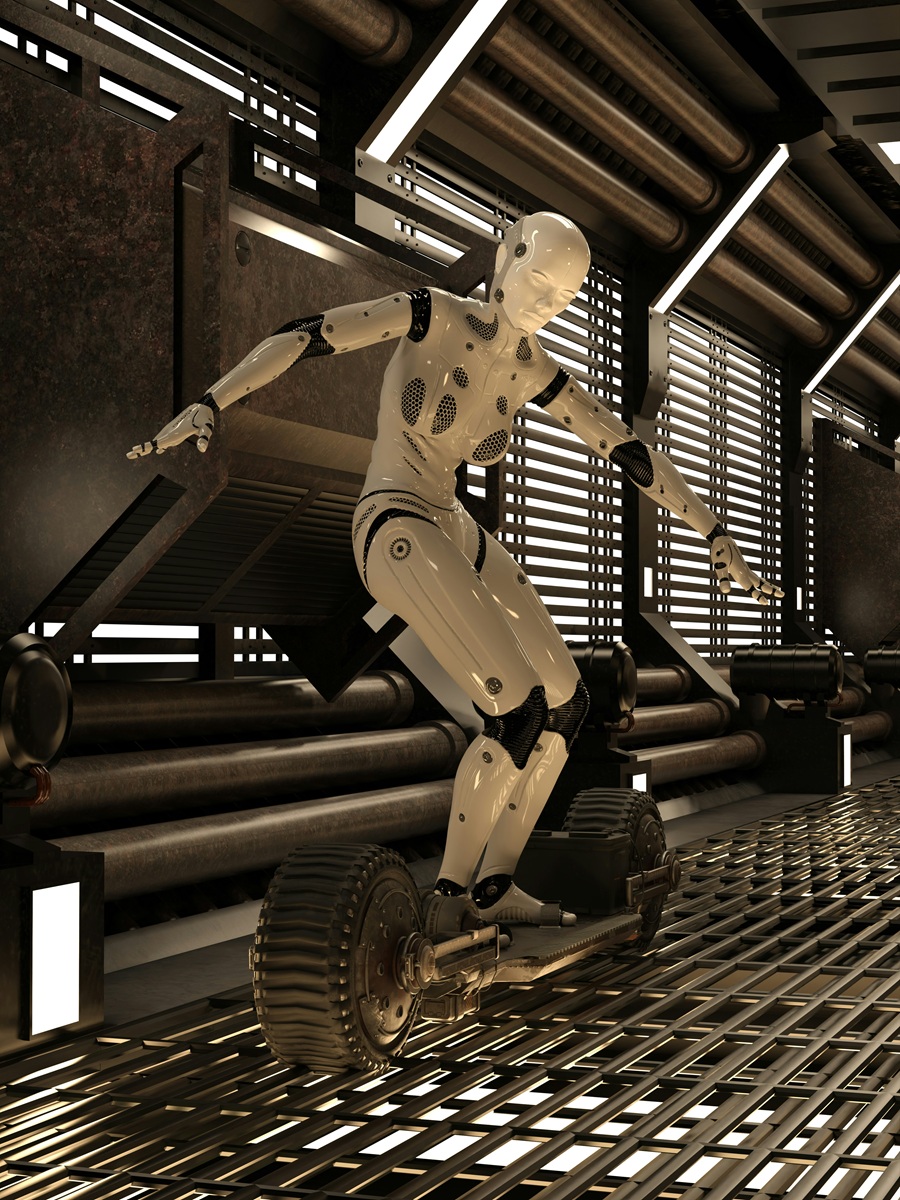
Miami AI Group ™ and Solarion Robotics ™ are conducting early research into how post-quantum security, machine identity and Compute Passport ™ technology could support trusted robotics control planes.
Executive Summary
Robotics systems are evolving from isolated machines into connected, software-defined platforms that combine artificial intelligence, autonomous decision-making, cloud and edge computing, sensors, APIs and remote control infrastructure. This transition creates a new cybersecurity problem: the identity, authorization and integrity of machines and autonomous software must remain trustworthy across increasingly distributed environments.
At the same time, organizations are beginning to prepare for a future in which cryptographically relevant quantum computers could weaken widely deployed public-key cryptography. NIST finalized its first three post-quantum cryptography standards in 2024 and has encouraged organizations to begin migration planning. This makes cryptographic agility and quantum-resistant architecture relevant to long-lived robotics and autonomous systems today.
01 — The Quantum Cybersecurity Transition
Post-quantum cryptography is designed to protect information against attacks from both conventional and future quantum computers. The transition is not simply an algorithm replacement. Enterprises must identify where public-key cryptography exists, understand certificate and key dependencies, modernize protocols and build the ability to change cryptographic mechanisms without redesigning entire systems.
This challenge becomes more significant for physical and autonomous systems. Robots, drones and other intelligent machines may remain deployed for years, operate across mixed networks and depend on embedded components with different update cycles. A security architecture designed for these systems should therefore assume that cryptographic requirements will change during the operational life of the machine.
02 — Why Robotics Changes the Security Model
A compromised enterprise application can expose data. A compromised autonomous machine can also affect the physical world. Robotics cybersecurity therefore requires controls that extend beyond traditional user authentication and perimeter security.
A modern robotics environment can include the robot, onboard compute, AI models, sensors, remote operators, fleet services, cloud APIs, software updates, telemetry pipelines and third-party tools. Each component creates a trust relationship. The control plane needs to determine which machine is connecting, which software is running, what that machine is permitted to do and whether its state remains within policy.
03 — Compute Passport ™ as a Machine Trust Layer
The early research explores Compute Passport ™ as a potential machine identity and trust layer within a robotics control plane. The concept is to provide a persistent, verifiable identity context for compute resources and autonomous systems rather than treating a robot as an anonymous endpoint on a network.
A Compute Passport could associate a machine with identity attributes, approved software state, authorization policies, cryptographic credentials, ownership or operational context and security telemetry. The control plane could then evaluate this information before allowing a robot or autonomous agent to access tools, services, commands or protected environments.
This is an early research direction rather than a claim of production deployment. The objective is to determine where identity-centric controls can improve robotics security and where additional hardware, protocol and cryptographic controls would still be required.
04 — A Quantum-Ready Robotics Control Plane
The proposed architecture separates trust decisions from individual robot applications. Instead, a control plane would provide centralized policy and identity services while allowing execution to remain distributed across edge devices and cloud infrastructure.
- Machine identity: establish a unique and managed identity for each authorized robotic or autonomous system.
- Cryptographic agility: support controlled migration between cryptographic algorithms and credential types.
- Post-quantum credentials: evaluate quantum-resistant key establishment and digital signatures where technically appropriate.
- Policy authorization: determine which commands, tools, data and environments a machine can access.
- Software integrity: connect machine identity with approved software, models and configuration state.
- Telemetry and audit: maintain evidence of identity events, authorization decisions and operational activity.
- Human control: preserve escalation, intervention and approval paths for higher-risk actions.
05 — Identity, Keys and Autonomous Agents
As robotics systems become more agentic, identity must extend beyond the physical device. A single robot may run multiple autonomous agents, models or task-specific services, each requiring different permissions. Research therefore needs to distinguish device identity, workload identity, agent identity and human operator identity.
Post-quantum cryptography could eventually affect how these identities authenticate and sign actions. The immediate architectural priority is crypto agility: designing identity and credential systems so cryptographic mechanisms can evolve without breaking the operational control plane.
06 — Research Questions
The joint research program is examining several questions: how machine identity should persist across hardware and software changes; how post-quantum credentials could be introduced without disrupting existing fleets; how a control plane should revoke or quarantine a compromised machine; how autonomous agents should inherit or receive permissions; and what telemetry is necessary to reconstruct high-risk machine actions.
Additional research will consider latency, constrained hardware, offline operation, certificate lifecycle management, secure software updates, fleet-scale key rotation and interoperability with existing enterprise identity and cybersecurity systems.
07 — Responsible Autonomy
Quantum-resistant security is only one component of trusted robotics. Responsible deployment also requires governance around autonomy, human oversight, safety boundaries, data handling, model behavior and accountability.
The research therefore treats cybersecurity and responsible AI as connected architectural disciplines. A machine that can authenticate securely but operate outside acceptable policy is not a trusted autonomous system. Likewise, a well-governed AI model cannot be considered secure if an attacker can impersonate its host machine or alter its software environment.
08 — From Research to Architecture
The intended outcome of this early work is a reference architecture for identity-centric, quantum-ready robotics security. Future research may evaluate prototype workflows in which a robotics control plane validates a machine passport, evaluates policy, verifies software state and records the authorization decision before allowing access to a protected command or service.
The work is exploratory. It does not imply that quantum computers capable of breaking current public-key cryptography are available today, nor that post-quantum cryptography alone resolves robotics cybersecurity. The goal is to design for technological change before long-lived autonomous infrastructure becomes difficult to retrofit.
Conclusion
The convergence of artificial intelligence, robotics and quantum-era cybersecurity creates a new infrastructure challenge. Autonomous machines will need identities that can be governed, credentials that can evolve and control planes capable of continuously evaluating trust.
Miami AI Group ™ and Solarion Robotics ™ are exploring whether Compute Passport ™ technology can provide part of that trust architecture. The research begins with a simple premise: as machines become more autonomous, their identity and authority must become more explicit, verifiable and resilient.
Research Context
This research direction is informed by the transition toward standardized post-quantum cryptography, including NIST’s FIPS 203, FIPS 204 and FIPS 205 standards and broader migration guidance. It is an independent research initiative and does not imply endorsement or affiliation with NIST or any government agency.
About Miami AI Group ™
Miami AI Group ™ is an independent artificial intelligence initiative focused on AI research, enterprise technology, emerging systems and responsible innovation. Miami AI Group ™ is operated by Miami Artificial Intelligence Group LLC.